

Samurai Warriors 5 Collector's Edition
Swords used by Japanese samurai were renowned for the craftsmanship which produced strong nevertheless flexible curved steel blades with a single, super-precipitous cut edge. Produced from the 8th century CE onwards and symbolic of the samurai'due south elevated status in Japanese society, many swords were both deadly weapons and family heirlooms. Fortunately, fine examples of Japanese medieval swords survive in museums worldwide today, and several are even listed equally official National Treasures of Japan.
Swords in Japanese Mythology
Reverence for swords goes dorsum a long way in Japanese civilization. A sword is one of the iii sacred Shinto relics that make up the Japanese imperial regalia. According to legend, Susanoo, the Shinto storm god, killed a giant ophidian called Yamato-no-Orochi (aka Koshi) which was terrorizing the province of Izumo. From the dead creature's belly, Susanoo discovered the special sword, the Kusanagi or 'grass-cutter' (in other versions of the story he extracts it from the serpent's tail). This sword, he presented to his sis Amaterasu who later gave it to her grandson Ninigi who was the first ancestor of the Japanese imperial family. In this way, the sword became a office of the majestic regalia, today preserved in the temple of Atsuta near Nagoya.
Swords feature prominently in other tales of Japanese mythology, especially in such works as the Kojiki ('Record of Ancient Things'), compiled in 712 CE by the court scholar Ono Yasumaro. Within this work, the oldest text of any kind from Nihon, great and magical swords go by such names as Heavenly-Point-Blade-Extended, Beard-Cutter and Great-Blade-Mower. Several special swords were considered kami or Shinto spirits in their own right. Not always considered a weapon of devastation, the Bodhisattva Kokuzo-Bosatsu of Japanese Buddhism, for example, is often depicted in Japanese art holding the sword of happiness in his right hand, a symbol of the bounty of sky.
Sometimes blades were tested for their cutting prowess, typically on a condemned criminal, & the results were occasionally noted on the blade itself.
The Sword as the Ultimate Weapon
Despite the sword'southward long history in myth and legend, information technology was actually the bow that was considered the primary weapon on the Japanese battlefield for much of the country's history. This state of affairs lasted until the Mongol invasions of the late 13th century CE which gave swords the opportunity to shine on a more than frenetic battleground than Japan had witnessed previously. The long and super-sharp Japanese swords proved far more effective than the Mongol short swords, and neither could the invaders' lite armour withstand the fearsome slashing blade of the samurai sword. Swords had, in fact, been used in Nippon since antiquity simply were of the direct-blade type and used for thrusting. By the middle of the Heian Flow (794-1185 CE), though, and the appearance of the samurai, it was the curved and viciously sharp sword they carried that saw Japanese swordsmanship reach its zenith.
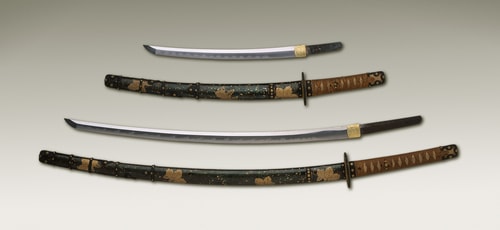
Samurai Swords
Although samurai often did not have any particular training schools, there were specialised schools of swordsmanship. Cut an object with a unmarried accident was specially practised and swordmen used every bit a target such items as bamboo, piles of tatami matting or bundles of straw. One rather unfortunate association with swords is the samurai warriors' infamous practice of testing their blades were still sharp by beheading total strangers on the roadside, a nasty habit known a tsujigiri or 'cutting down at the crossroads.'
Swords became exclusively associated with the samurai after 1588 CE when Toyotomi Hideyoshi (1537-1598 CE) promoted a lasting peace by forbidding anyone but members of the warrior form from carrying weapons. This was a strategy attempted by his predecessors and information technology became known as 'sword hunts' (katanagari) when officials ensured that nobody outside the government's army possessed swords, bows, spears, or muskets.
The Art of Steel Manufacture
Samurai sword blades were fabricated in specialist workshops using steel in a manufacturing procedure which dated back to the Nara Period (710-794 CE). The steel was worked by chief craftsmen who carefully controlled the carbon content in diverse parts of the bract for maximum force and flexibility, as hither explained by the historian W. Due east. Deal:
…during the Nara period, these technologically avant-garde blades were made of densely forged steel laboriously hammered, folded and welded multiple times in society to create a steel fabric of superior flexibility and integrity. Due to this process, Japanese-style blades take a complex, multilayered structure similar to the grain of wood, with a more flexible, lower carbon-content steel encased in (or layered with) a harder, more than brittle outer surface that is exceptionally durable. The deviation in the carbon content of the steel and the positioning of the contrasting metals also results in the feature curve of Japanese swords. (159)
Swordsmiths were non only admired and given a high social condition for their applied skills but they too enjoyed a certain religious mystique thank you to their frequent association with Buddhist sects and their management of iii of the five fundamental elements in Japanese folklore: fire, h2o, and metal.
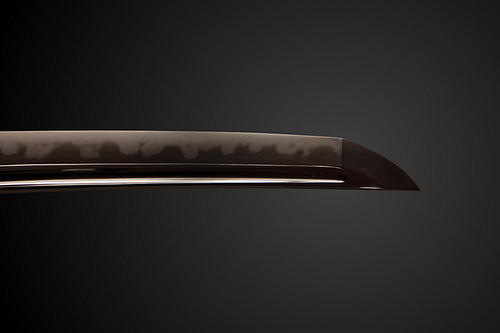
Hamon of a Samurai Katana Blade
One time the smith was finished with the bract, it was passed on to a sharpener and polisher who used varying grades of stones with water to attain a gleaming blade. And then, returned to the smith, the finished blade was given its engraving which included the maker's signature. Sometimes blades were tested for their cut prowess, typically on a condemned criminal, and the results were occasionally noted on the blade itself. The day of industry and the name of the recipient might also be recorded on what became a busy writing space. There were even cases of less-gifted swordsmiths signing their swords as the work of more than famous craftsmen in order to increase sales.
Some other and much more sophisticated mark of identification of merely who manufactured a sword was the hamon or the temper pattern of the cutting border. This was achieved in the following procedure:
The hamon is a synergistic consequence of 3 events that contribute to the terminal hardening of the sword's cutting surface. First, clay is applied to the blade and allowed to dry out. So, the sword is repeatedly passed through a loftier-temperature charcoal fire for a specified corporeality of fourth dimension, until it reaches the temperature desired by the smith. Finally, the bract is plunged into a tank of water, calibrated precisely to complement the amount of fourth dimension spent in the fire at a sure temperature. The combination of these three factors determines the form of the hamon and is a closely guarded secret in each smith's workshop. (Deal, 159-160)
The production of swords received support correct from the very tiptop with such notable figures as emperor Go-Tobo (r. 1184-1198 CE) enticing 12 master swordsmiths to his workshop at Heiankyo (Kyoto). Although these masters, collectively known as Ban-kaji, were in such need they could but be persuaded to spend one calendar month each year at the capital. The most esteemed swordsmiths often formed their own manufacturing schools, every bit was the case with Goto Yujo (d. 1512 CE) whose school lasted 400 years.
Japanese swords were in much demand in Medieval Red china where they could be sold at a 500% turn a profit.
With all this care and attending combined with technical expertise in steelworking, it is off-white to say that Japanese swords were amongst the finest and sharpest ever produced in the medieval world. Certainly, Japanese swords were in much demand in medieval Red china where they could be sold at a 500% profit throughout the medieval catamenia.
Types of Swords
Samurai swords were slightly curved, and blades varied in length, but it became common for elite samurai to carry ii swords - a long and a short one. This pair became known as the daisho ('cracking and small') from the 1580s CE and were usually made to match in terms of colour and ornamentation. The longer sword (katana) had a bract of around lx cm (2 ft) and the shorter sword (wakizashi or tsurugi) had a blade of xxx cm. Both swords were worn with the cutting edge uppermost and the short sword was the one worn when the samurai was indoors. Earlier the katana sword came along there were 2 larger swords. The 'mallet-headed' sword, which had an especially heavy pommel to balance the bang-up length of the blade, and the tachi, which had a blade of up to 90 cm (3 ft). A tachi sword was worn with the cutting edge facing down, hung suspended from the belt using cords while the other types were thrust through the belt.
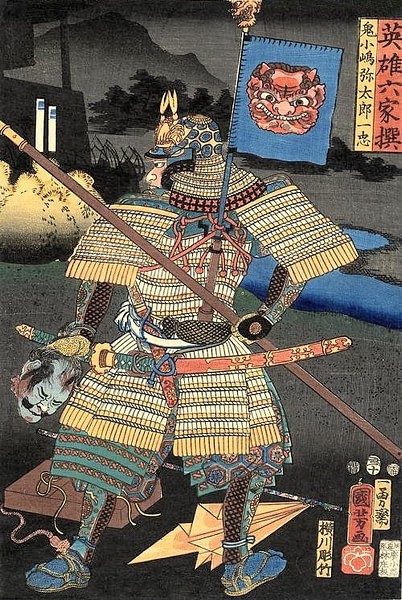
Samurai Onikojima Yataro Kazutada
Sword handles (tsuka) were made of woods and covered in the tough skin of the giant ray (same) and and then tightly bound in silk complect, typically of a dark blueish color. The bract was separated from the handle by a minor circular hand guard (tsuba). The handle, often a work of art in its ain right, might be protected past a metal sleeve (fuchi) which could exist decorated, like the handle itself with landscape scenes and relief figures of such favourite subjects as lions and dragons. A samurai might likewise carry a short dagger (tanto) as a weapon of terminal resort (distinguishable from the short sword by its lack of a handguard). Both swords and daggers were kept in lacquered scabbards which could be highly decorative but were more oftentimes minimalist in design. Finely-worked swords took a long time to brand, and they were often given as a gift of gratitude to samurai by their lord and then passed downwards every bit family heirlooms. Stands and racks to display fine swords in the home became still another area for artists to express their skills in carving and metalwork.
Finally, the sword of a samurai was an essential part of the ritual suicide known equally seppuku which many warriors were expected to commit if their lord were killed or they lost a battle. Cut their belly with a pocketknife stroke from left to right, an assistant was usually on hand with a special sword, known as a kaishakunin, to swiftly decapitate the samurai.
Decline in Use
With the introduction of European firearms to Nippon in the mid-16th century CE, the sword began to go into decline. So much history and sociology were attached to Japanese swords, though, that their mystique far outlasted their practical use in battle. Swordsmanship remained an admired skill amongst Japan's elite; Tokugawa shoguns had their ain personal instructors in order to strop the technique. Merely as medieval samurai were eulogised in the literature of the pre-mod era, so, too, swords were held up as the ideal fighting weapon of the now-long-gone chivalrous warrior. Around 1643 CE, for example, the famous Gorin no sho ('Volume of Five Rings') was published. Written by Miyamoto Musashi, a former master swordsman and developer of the two-sword technique known equally nito-ryu, it examined swordsmanship and extolled the loyal service of samurai who existed only to serve their lord. Afterwards 1867 CE retired samurai were no longer permitted to deport swords. Fortunately for posterity, a nifty number of swords accept outlasted their owners thank you to the reverence paid to these valuable works of craftsmanship. Today, museums worldwide contain many fine examples of samurai swords, especially the koto or 'sometime swords' which were made earlier 1600 CE; several of these masterpieces are listed as official National Treasures of Japan.
This content was made possible with generous back up from the Nifty Britain Sasakawa Foundation.
This article has been reviewed for accuracy, reliability and adherence to academic standards prior to publication.

Samurai Warriors 5 Collector's Edition,
Source: https://www.worldhistory.org/Samurai_Sword/
Posted by: danielhatemaked.blogspot.com
0 Response to "Samurai Warriors 5 Collector's Edition"
Post a Comment